How to Choose a Power Station for Camping (2026 Guide)
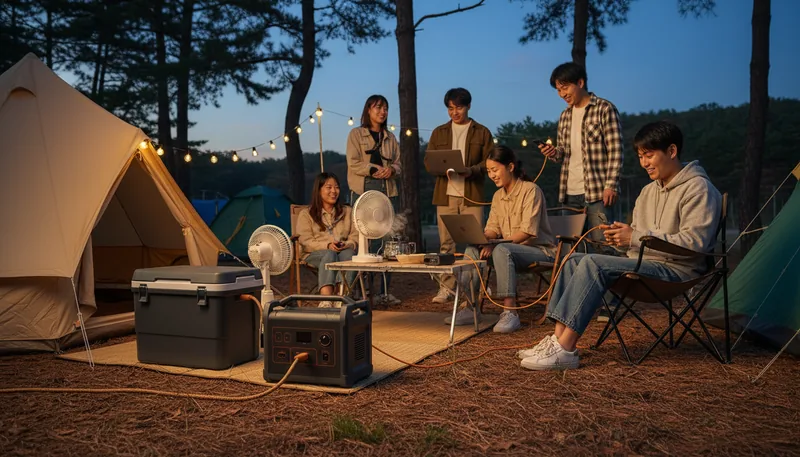
A camping power station lets you keep your phone charged, run an electric cooler, power a fan on hot nights, and watch movies on a laptop — all without a noisy generator. But picking the wrong size means either running out of juice at midnight or lugging a 38 kg brick to a campsite. This guide walks you through exactly how much power you need, which features matter for camping specifically, and which products scored highest on our database of 112 ranked power stations.
1. How Much Power Do You Need?
2. Key Features to Look For
3. Our Top Picks for Camping
OUPES Mega 2
Best all-round value for car camping — 2,048 Wh, 22 kg, $679. Powers cooler + devices for a full weekend.

VTOMAN FlashSpeed 1500
Great mid-range pick — 1,548 Wh, 18.8 kg, $539.99. Light enough to carry easily, enough power for 2-3 nights.

EcoFlow Delta 2 Max
Best for frequent campers — 2,048 Wh, 30 dB ultra-quiet, 3,000-cycle battery survives years of regular use. $849.

OUPES Mega 3
Best high-capacity pick — 3,072 Wh, 3,600W output, $1,099. For group camping or extended trips with heavy devices.

4. Common Mistakes to Avoid
5. Sizing by Trip Type
VTOMAN FlashSpeed 1000
Compact and light enough for couples camping — 1,000 Wh covers 2 nights of phones, speaker, and lighting.

VTOMAN FlashSpeed Pro 3600
Top-rated for camping by our scoring system — 3,096 Wh and 3,600W output for serious basecamp setups. $1,329.

Summary: The Bottom Line
For most car camping trips, a 1,000-2,000 Wh power station weighing under 23 kg hits the sweet spot between capacity and portability. Prioritize weight and noise level over raw wattage, factor in 20-30% cold weather capacity loss if you camp in cooler conditions, and don't count on solar charging under tree cover. The OUPES Mega 2 ($679, 2,048 Wh) and VTOMAN FlashSpeed 1500 ($539.99, 1,548 Wh) are our top picks for the most common camping use cases.
Frequently Asked Questions
What size power station do I need for camping?
For a typical car camping weekend with a phone, LED lantern, and small fan, 500-1,000 Wh is sufficient. Add an electric cooler running overnight and you need 1,500-2,000 Wh. Calculate your total daily watt-hours by multiplying each device's wattage by the hours you'll run it, then add 25% for efficiency losses.
What is the best power station under $500 for camping?
The VTOMAN FlashSpeed 1500 at $539.99 is close to that budget and offers 1,548 Wh — more than enough for most camping trips. For strictly under $500, look for 500-1,000 Wh units from brands like EcoFlow or Jackery that regularly go on sale. Avoid very cheap no-name units under $200 with 1,000 Wh claims — battery chemistry quality varies widely.
Can I use a power station to run an electric cooler while camping?
Yes. A typical 12V electric cooler draws 40-80W. Running it overnight for 8 hours uses 320-640 Wh. A 1,000 Wh power station can keep a cooler running for 12-16 hours. The key is to pre-cool the cooler contents before your trip so the unit doesn't have to work as hard once you're off-grid.
Are power stations quiet enough for camping?
Yes — this is one of their biggest advantages over gas generators. Modern power stations produce 30-45 dB of fan noise under load, which is quieter than a normal conversation. Compare that to a gas generator at 65-75 dB, and the difference is dramatic. The EcoFlow Delta 2 Max, for example, is rated at just 30 dB.
How do I keep my phone charged while camping without a power station?
A dedicated camping power bank (like a 30,000 mAh USB bank) can charge a phone 6-10 times and costs under $50. For a weekend trip with basic needs, a quality power bank is cheaper and lighter than a full power station. But if you also want to run a cooler, fan, or laptop, a proper power station is the better investment.
Do power stations work in cold weather camping?
They work, but with reduced capacity. Standard lithium-ion (NMC) batteries lose 20-30% of their rated capacity below 0°C (32°F). LiFePO4 batteries handle cold better and are the preferred choice for winter camping. Most manufacturers list a minimum operating temperature — typically -10°C to -20°C — below which the unit may not function at all.
Can I charge a camping power station with solar panels?
Yes, and it is the ideal setup for multi-day trips. Check the station's maximum solar input (in watts) — a 200W solar panel paired with a 1,000 Wh station can fully recharge in 5-6 hours of direct sun. In partial shade or under trees, expect the effective input to drop to 30-50% of the panel's rated output, so plan accordingly.